You’ve picked the spot. A flat corner of the yard, close to the alley, out of the way of the kids’ swing set. Before you order the shed kit or call a contractor, stop and look at what’s actually marking your property line back there.
Property line markers are the small metal pins, rebar, or capped monuments that a licensed surveyor set to identify where your property legally ends. They’re not always where you think. A lot of homeowners assume the boundary runs along an old fence, a row of trees, or a line they’ve mowed for years. That assumption can be off by a few feet, and a few feet matters when you’re placing a permanent structure.
Finding the marker, or having one located, is the starting point. What you do with that information for shed placement is a separate question, and it’s one that trips up more homeowners than you’d expect.
A Marker Can Be a Useful Reference, But It Is Not the Setback Line
Here’s where a lot of shed projects go wrong. A property line marker tells you where your land ends. It does not tell you how close you’re allowed to build to that line.
That distance is called a setback. It’s a rule set by your city or county zoning code, and it’s separate from the boundary itself. Your shed might need to sit five feet from the line, ten feet, or more, depending on where you live and what kind of structure you’re building. The marker gives you a fixed point to measure from. The setback tells you how far from that point your shed actually needs to be.
Setback rules aren’t the same across Iowa. Jackson County, for example, notes that setbacks vary according to the zoning district, the type of structure, its location on the lot, and other circumstances specific to the property. That’s normal. Every jurisdiction sets its own standards for accessory structures like sheds, garages, and small additions.
So before you dig or pour a foundation, check with your local zoning office. Don’t guess based on what a neighbor did or what seems reasonable. The marker is your reference point. The zoning code is your rule book.
Use the Shed Footprint Before You Dig
Once you know the setback distance, measure from the actual footprint of the shed, not just where you picture the walls sitting.
That means accounting for the full width and depth of the structure, plus anything that sticks out past the walls. Roof overhangs count. So do steps, ramps, and any attached features like a small deck or door swing. If your shed has a two-foot overhang on one side, that overhang might be the part that actually determines whether you meet the setback, not the wall beneath it.
Your local zoning office decides how these measurements are taken, and that detail matters more than people expect. Jackson County, for instance, states that applicable setbacks can be measured to the furthest projecting portion of a proposed structure, depending on the specific rule involved. That could mean your setback calculation starts at the edge of the roofline, not the wall.
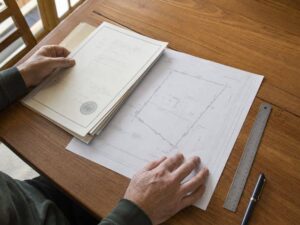
Before you stake out the shed, sketch the full footprint, including anything that extends past the main structure. Measure from that outer edge to the property line marker, not from the center of where you think the shed will sit. It’s a small step that prevents a costly mistake once concrete is poured.
When the Marker and Your Measurements Do Not Agree
Sometimes things don’t line up. The visible marker seems to be in a strange spot. The fence doesn’t match the GIS map. An old plat or sketch from years ago shows something different than what you’re seeing on the ground.
When that happens, don’t move the marker. Don’t treat the fence line as proof of where the boundary actually sits. Fences get built for convenience, not legal accuracy, and they shift over decades. A GIS parcel map is a useful tool for a general idea of where your lot lines fall, but it’s not a legal record of your boundary.
Iowa county guidance backs this up directly. GIS parcel lines are described as useful for general reference, but not a substitute for a survey when the exact property line is in question. If your shed is going to sit close to the required setback, and you’re not confident about exactly where the boundary is, that’s the moment to get professional verification rather than build on an assumption.
A few feet of uncertainty might not matter for a shed set well inside your lot. It matters a lot when you’re building near the edge.
Give the Shed Room to Stay Out of Trouble
Bring it back to what you’re actually trying to do: place the shed once, correctly, without digging it up later because it’s too close to the line.
That means checking your local zoning and building requirements before you start. It means knowing your shed’s full footprint, including overhangs and attached features. It means confirming the property boundary itself, especially if the marker doesn’t match your expectations or the shed is going in near the setback line.
Accessory structure rules vary by jurisdiction across Iowa. The state’s residential construction rules incorporate the residential code, but local zoning still governs where a shed, garage, or similar structure can sit on your lot. Both layers apply, and skipping either one can cause problems down the road.
A property line marker gives you a starting reference point. It’s not permission to build right up to it. Confirm the setback, confirm the footprint, and confirm the boundary if there’s any doubt, before the shed goes in the ground.
Frequently Asked Questions
Can I place a shed right next to a property line marker?
Not necessarily. A property line marker identifies or helps reference a boundary location, while zoning regulations may require a separate setback between the property line and an accessory structure. Check the requirements for the specific Iowa jurisdiction before choosing the shed location.
Does a property line marker show where my shed’s setback begins?
No. A marker and a setback serve different purposes. The marker relates to the property boundary, while the setback is a required separation established by applicable zoning or other regulations.
What if the property marker is missing where I expected it to be?
Do not assume the boundary based solely on a fence, landscaping, a GIS parcel map, or another visible feature. If the exact boundary matters to the shed location, professional boundary verification may be appropriate. Jackson County specifically cautions that GIS parcel lines are not a substitute for a survey when the exact property line is uncertain.